
Rare shark in UK waters beheaded by trophy hunters after being washed up on beach

By Mick the Ram
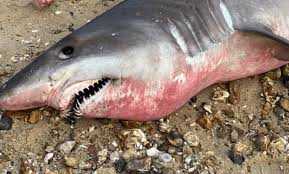
A shark, believed to be the first of its species to be found in UK waters, has been washed ashore on a popular south coast beach, but before scientists could examine it, the creature had been mutilated by “trophy-hunters” who removed the head, dorsal fin, and tail.
The two metres long fish is thought to be a Small-Tooth Sand Tiger shark and was discovered by walkers on Lepe beach in Hampshire, a stony stretch which forms part of the Lepe Country Park, situated in an Area of Outstanding Natural Beauty, straight across the Solent from the Isle of Wight.
Soon after photos of the creature were posted on social media platforms, a respected biologist identified the species, pointing out that they are “exceptionally rare visitor to these shores” usually preferring much warmer waters.
After an appeal was made for the body parts to be brought back, if only temporarily, to allow a proper examination, it emerged that a mother-of-two, had come across the shark struggling earlier and she actually believed she had saved it by dragging it out of the shallows and into deeper waters; but sadly it found its way back and seems to have been unable to escape for a second time and has ended up on the beach.
Brave local woman initially pulls shark to safety
The drama began when Alisha Openshaw, a 38-year-old local mother-of-two, was on the beach with her children, when her attention was caught by a crowd watching the shallows. On investigating she realised it was a shark in difficulties, but said nobody was helping the poor creature, so she decided to take matters into her own hands… literally.
She waded into the water and bravely dragged the shark back out to deeper waters and she said she saw it swim away, seemingly to safety. However, it may have exhausted itself in its struggles, which are thought to have lasted at least two hours and it seems to have been washed back ashore.
Ms Openshaw, from Dibden Purlieu, Hants, said: “At first I wasn’t sure what it could be, but once I got there I could definitely see it was a shark and I just couldn’t believe nobody tried to help him.” She explained how she pulled the creature by its tail and watched it head off in the direction of the Isle of Wight.
“I don’t want any animal to suffer, I can’t even kill a fly myself, and I knew I just wanted to save him,” she said, before adding that it wasn’t until she got into the water that she realised just how big it was. Speaking about the removal of the shark’s head, she admitted it had really upset her describing the act as “barbaric”.
Long way from home
Usually found in much deeper waters, it is unclear what this Small-Tooth Sand Tiger shark was doing in the chilly Solent, as it is not familiar with the British shores, and is known to prefer much warmer waters. This particular type of shark is actually non-aggressive towards humans and is regarded as a strictly-protected species, which can grow up to 4 metres or 12 feet in length, suggesting that this one may have been relatively young. According to the International Union for Conservation of Nature, there are thought to be fewer than 250 adult Sand Tiger sharks left.
Historian makes heartfelt appeal for return of head
Broadcaster and historian Dan Snow, who lives very close to the area, has appealed to those responsible for taking the head to return it, with a promise to make no judgement and allow them to take it back after scientific examinations are carried out. He said he had been in discussions with a biologist who was desperate to study what was described as a “once-in-a-lifetime find of an incredibly valuable shark in British waters”.
Mr Snow put out a plea on Twitter for whoever had the head to bring it back, making the point that it was a rare opportunity for researchers to have access to this species of shark and scientists desperately wanted to undertake a study to “help us learn about the health of our oceans and the effects of climate change.” He tried to reassure those who took the body parts that they could have the jaw back if they wanted it for a clubhouse, or to display somewhere, but pleaded with them to do the “community spirited thing”.
Important research opportunity could be missed
The Shark Trust has also issued a plea for the head to be returned, describing the Small Tooth Sand Tiger sharks as “exceptionally rare visitors” in waters north of the Bay of Biscay, off northern Spain. Their Director of Conservation, Ali Hood, explained how important recovering the head would be as having the opportunity to carry out analysis of atoms in the lens of the eyes, through a technique known as “stable isotope analysis”, can help identify where a shark was feeding, and therefore possibly plot its journey to the UK coast.
She added that keeping specimens intact is preferable, but reiterated that examining the head was vital: “There is so much we are yet to learn and the head in particular holds the key to unlocking intricate details of the shark’s life, even from before birth.”
Professor makes Roman comparison
Dr Ben Garrod, a professor in evolutionary biology at University of East Anglia, also was desperate to study the sharks head as it offered a “snapshot” of animals living in international waters. “The oceans cover 71 or 72% of our planet, however it is still incredibly mysterious,” he said, before comparing the occurrence’s of sharks being washed up, or a whale breaching, to being similar to finding a Roman hoard or Viking daggers, and in this case, with the species not typically seen on UK shores, it could offer an insight into feeding patterns and water temperatures.
Mr Snow, along with several other local residents, managed to secure the remainder of the carcass and this will be collected this week by the London Zoological Society, to be taken away for studies to be made on it.

Preference for warm waters
The Small-Tooth Sand Tiger, or Herbst’s Nurse Shark, usually appears in tropical and warm-temperate latitudes; spotted off places like the Canary Islands, Morocco, the Azores, Florida, Brazil, Mexico, Madagascar, the Maldives, and Colombia, amongst others. Average age has not been fully determined for this species, which is one of the reasons why this presented a fantastic opportunity to study the brain of this particular unfortunate creature.
Not the most handsome of creatures
It is a slightly odd looking specimen with pointed bulbous snout, small eyes, spike-like teeth protruding in all directions, and small, equal size dorsal and anal fins. They normally feed on small bony fishes, squids, and crustaceans and as a docile, non-aggressive species, they are not known to attack people, meaning that Ms Openshaw was probably never in danger when performing her kind act.
They mainly live close to the seabed around rocky habitats, in continental deep waters. At least three countries protect this shark within the Mediterranean sea, Spain, Malta, and Croatia.
Several species of shark make UK waters their home
While this unfortunate creature was seemingly a long way off course, sharks are not actually uncommon in UK waters, with over 40 different species identified at certain times, although only 21 of these are specifically found all year around.
The most common are the Basking shark, which although able to reach upwards of 12 metres in length, they are actually real gentle giants, feeding mostly on plankton. The Porbeagle is also one that is spotted often, sometimes causing anxiety with its resemblance to the great white, but there has never been a confirmed case of an attack on a human.
Others regularly found include: the Dogfish, the Tope, the Spur-Dog, the Smooth Hammerhead, the Leaf-Scale Gulper, the Thresher, the Common Skate, the Velvet Belly Lantern, the Blunt-Nose Six-Gill, and the Tiger. The most dangerous sharks lurking around British shores are the Oceanic White-Tip, the Nurse, the Short-Fin Mako, the Nurse-Hound and the Angel.
This story was first published by Antigua News on : antigua.news/2023/03/20/rare-shark-in-uk-waters-beheaded-by-trophy-hunters-after-being-washed-up-on-beach. © 2023 Antigua News. Republication without permission is not allowed.

About the author
Mick Burrows is an independent freelance author based in the UK, boasting over 20 years of experience in the online writing landscape. His extensive background has enabled him to develop a diverse range of material, marked by a unique and distinct style. Recognized as a platinum-level expert author by leading e-zine publications, Mick excels in optimizing content for Search Engine Optimization (SEO) through effective keyword density and distribution. He has served as the lead reviewer for a travel enterprise and the senior previewer at a sports prediction company, melding his passions for sport—particularly football and cricket—with his love for travel, having explored more than 50 countries worldwide.
Read our editorial standards and corrections policy. Spotted an error? Contact the newsroom.
More from Style
View section
A Garden Fence, Ten Years in Court and a £1 Million Legal Bill
A 95-year-old woman won damages against her neighbours but failed to recover the wider costs of a boundary dispute. The courts called the result a draw.
By Dario Item

Julio Iglesias Faces Spanish Inquiry Over Caribbean Abuse Claims
A Spanish judge has opened an investigation into allegations by two former employees, after prosecutors initially said Spanish courts lacked jurisdiction. The singer denies wrongdoing.
By Dario Item

Sony Brings Back the Walkman Look With One Small Catch
The new MDR-3R headphones revive a familiar design from 1979. Their connection to the present makes for an awkward family reunion.
By Dario Item

When a Pineapple Was the Ultimate Status Symbol
Europe’s aristocrats went to extraordinary lengths to put a tropical fruit on the table. Antigua has a more practical way to enjoy it.
By Dario Item
Comments
Be the first to comment.