
Eighty Per Cent Is Not Consent: Majority Preference Does Not Decide Private Rights at Jolly Harbour

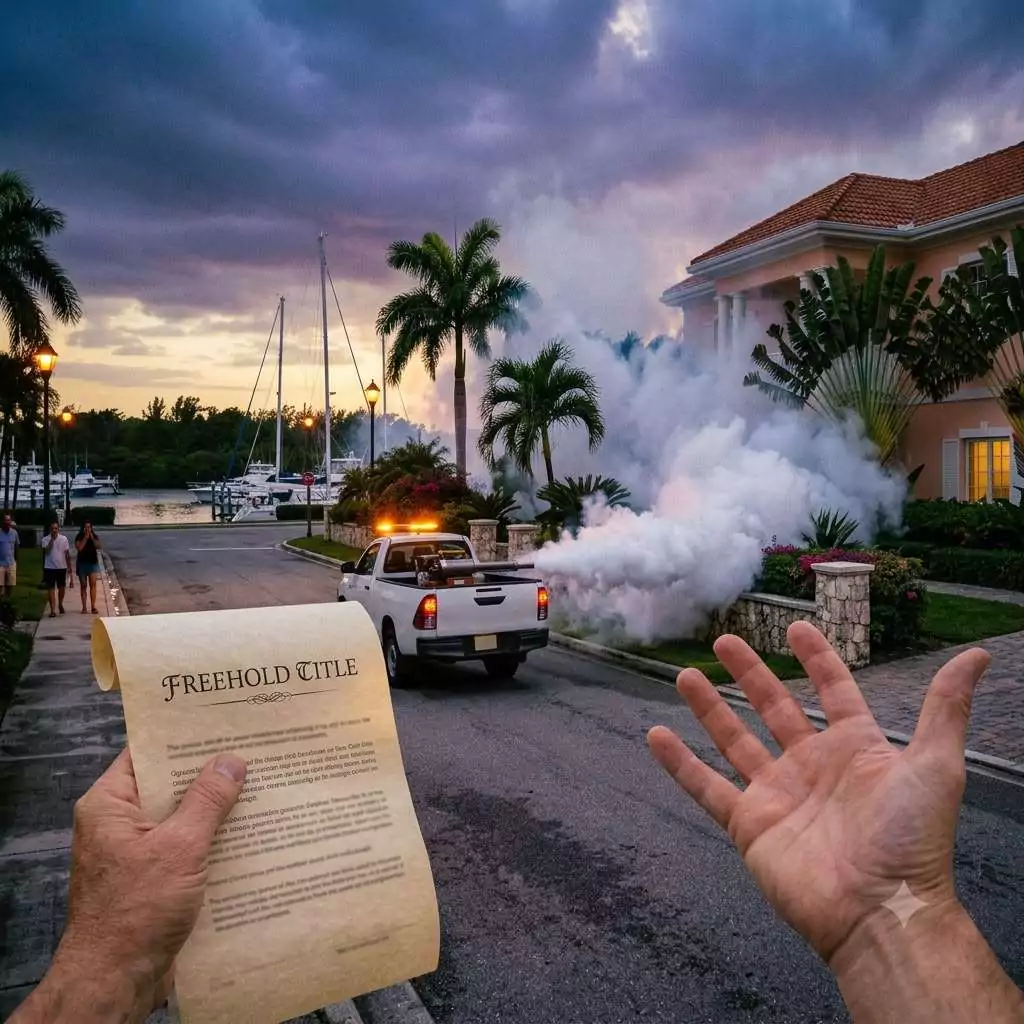
A judge of Antigua’s High Court has held that a freeholder’s private property rights are not decided by what the majority of his neighbours would prefer.
The sentence is short, and it is likely to outlast the case that produced it:
“The vindication of private rights in trespass and nuisance is not a matter to be determined by majority preference.”
In a development of some 850 owners where almost every objection is met with the reply that most residents are content, that holding reaches a great deal further than the dispute it came from.
The ruling was delivered on 9 July 2026 by Madam Justice Birnie Stephenson, in a claim brought by Jolly Harbour freeholder Cyprian Kowalczyk, who represents himself, against Caribbean Developments (Antigua) Limited (CDAL) over the developer’s chemical mosquito fogging. The interim injunction he sought was refused, on the balance of convenience. He has said he will appeal; an appeal against the refusal of an interim injunction lies as of right, and the time to bring it has not expired.
The argument the Court rejected — three times
The developer put the community argument to the Court in three forms. It was rejected in all three.
First, as a headcount. CDAL relied on a 2023 survey which, on the Court’s description, indicated that “some 80% of the community favours fogging” — the familiar answer at Jolly Harbour: most owners do not object, so the objector must give way. The Court gave it little weight. The survey, it held, was “not determinative of any question in issue” and was “at most, a modest indication of community reliance”.
Second, as a bar to suing at all. CDAL argued that the claimant lacked standing to restrain a community-wide activity on the basis of harm to a single parcel — that one owner, in effect, cannot challenge something done for everyone. The Court rejected it: ownership of the affected parcel “ordinarily confers a sufficient interest to sue in trespass and private nuisance”. The developer’s submissions about community reliance, the judge held, went “to the balance of convenience and to remedy, not to the existence of a cause of action”. Such arguments may bear on what remedy a court grants. They do not bear on whether the right exists.
Third, as a public interest that outweighs the right. Here the judge accepted that the public interest may be a weighty consideration — and it is ultimately why she refused the injunction sought. But she recorded the limit on it: an injunction remains the prima facie remedy for an established nuisance, and “the public benefit of an activity informs the form of relief rather than extinguishing the underlying right”.
That is the distinction the ruling turns on. Public benefit can shape what a court orders. It does not cancel what an owner holds.
What the 2023 survey actually was
The instrument behind the headline figure will be familiar to owners. On the fogging question, 122 answered yes and 30 answered no — 152 responses, in a development the Court put at some 850 owners. So the eighty per cent is eighty per cent of the fewer than one in five owners who answered: about 122 owners in 850. Among those who did answer, one in five said no.
The surveys are conducted online through an open link, with no identity verification: anyone holding the link can vote, and nothing establishes that a respondent is an owner or that an owner votes once. Results and data that do not favour the developer are not published, or are removed from publication after release.
The survey also complicates the word “community”. Asked how much of the year they spend at Jolly Harbour, only 22.44% of respondents said it was their primary residence, and roughly two-thirds said six months or less.
And the majority is not always followed. The same survey asked owners how interested their household was in a list of proposed facilities. On pickleball, a clear majority said they were not interested — 60.54%, or 89 of the 147 who answered. The courts were built anyway, and charged to owners.
The eighty per cent is quoted. The sixty per cent was not.
The same survey also priced the programme in the developer’s own words: “Continuing with the fogging of mosquitos? Approximate current cost = $16.00 EC per property per month.” The thirty owners who said “no” are billed for it as well.
“Thirty owners put their objection in writing,” Mr Kowalczyk said. “Nobody has explained to those thirty why their property rights turn on the other hundred and twenty-two.”
Why it reaches past mosquitoes
The principle is not confined to fogging. A survey measures preference. A freehold is a legal right. The first does not determine the second — and that distinction applies to anything a developer decides to do to, or charge for, land it has already sold.
Nor is it confined to this development. The reasoning is ordinary property law: an owner’s entitlement is not put to a vote of the neighbours, and a developer that retains land and sells the rest does not acquire, by majority sentiment, a licence over what it has sold.
“That is the principle I went to court for,” Mr Kowalczyk said. “At Jolly Harbour every objection gets the same answer — most owners don’t mind, so sit down. A majority cannot vote away what belongs to a neighbour. It makes no difference whether the subject is fogging or fees.”
The sentence that survives
Whatever becomes of the injunction, the holding stands: private rights are not decided by majority preference. Every freeholder at Jolly Harbour who has been told that most owners do not object now has a judge’s answer to that argument.
Whether an eighty per cent survey — in truth the view of about 122 owners in 850 — can license what is done to the rest is a question reaching well beyond mosquitoes.
The proceedings continue.
This story was first published by Antigua News on : antigua.news/2026/07/26/eighty-per-cent-is-not-consent-majority-preference-does-not-decide-private-rights-at-jolly-harbour. © 2026 Antigua News. Republication without permission is not allowed.

About the author
The Editorial Staff refers to all reporters employed by Antigua.news. When an article is not an original creation of Antigua.news—such as when it is based on a press release, other media articles, letters to the editor, or court decisions—one of our staff members is responsible for overseeing its publication.
Read our editorial standards and corrections policy. Spotted an error? Contact the newsroom.
More from Antigua and Barbuda
View section
LETTER: More Than a Number: What the Class of 2026 Tells Us
Professor C. Justin Robinson reflects on UWI Five Islands’ largest graduating class, its pioneering achievements and the need to bring more men into higher education.
By Shermain Bique-Charles

Idris Elba and Senator Jamilla Kirwan to Headline One Commonwealth Night as Hosts
Star-studded cultural celebration at Sir Vivian Richards Stadium will bring together international talent and local performers during CHOGM 2026.
By Cory Wayland

Regional Troops Arrive in Antigua and Barbuda to Strengthen CHOGM Security Preparations
Cayman Islands Regiment personnel join a regional military effort to support security, logistics and event operations ahead of the November summit.
By Cory Wayland

Police Outpost and Management Office Approved for Pelican Court
Cabinet establishes dedicated arrangements for security, maintenance and community concerns at the housing development.
By Shermain Bique-Charles
Comments (7)
Pee Wee July 26, 2026, 5:30 PM
Jon C July 26, 2026, 5:40 PM
Fogging Survivor July 26, 2026, 8:26 PM
Fog Expert July 27, 2026, 4:06 PM
Collin B July 26, 2026, 9:01 PM
Walter July 27, 2026, 11:03 AM
Jake July 27, 2026, 11:59 AM