












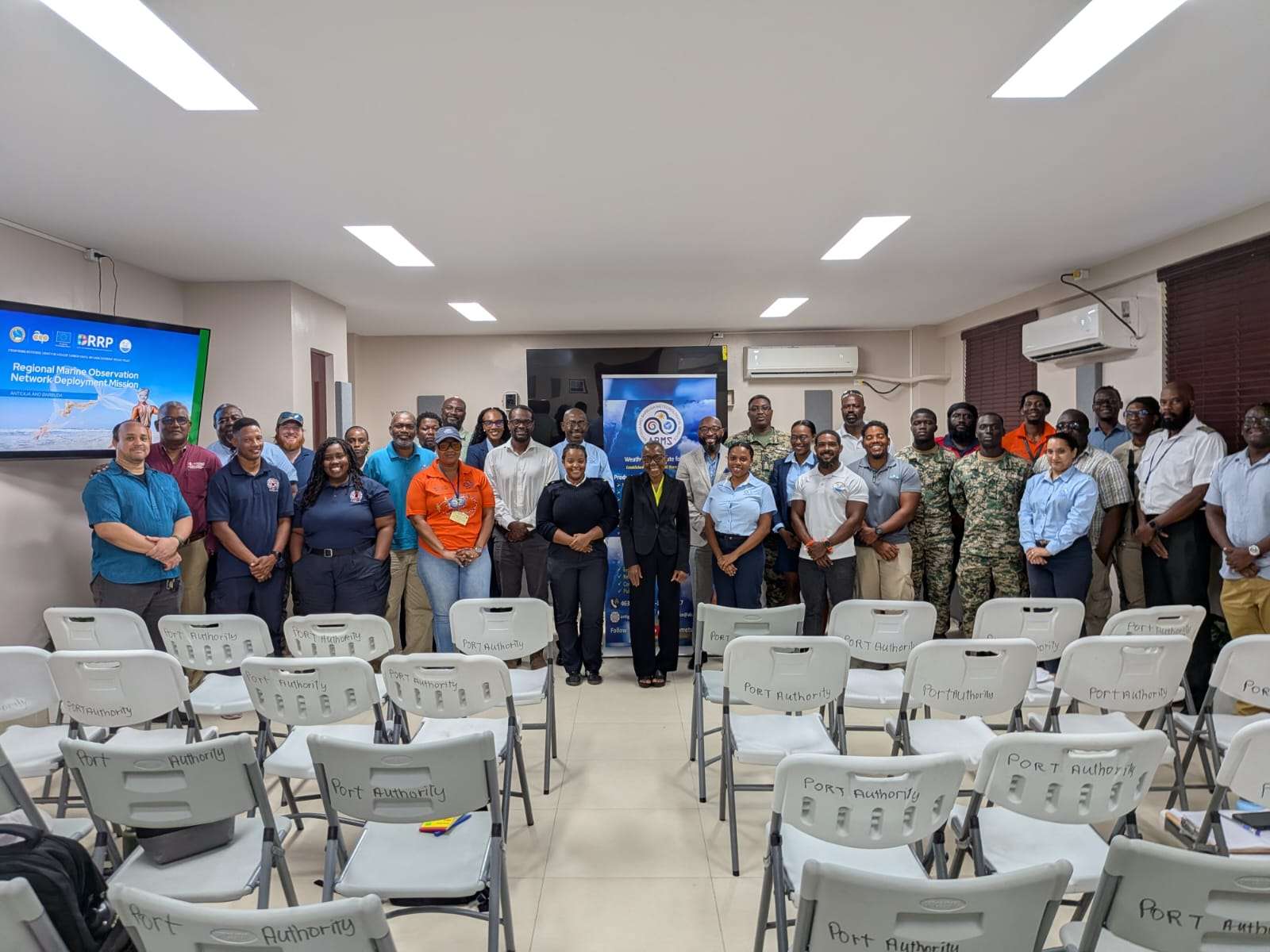
Antigua and Barbuda has received three SOFAR Ocean Data Buoy Stations in a major upgrade to the country’s marine forecasting, climate monitoring and early-warning capabilities.
Minister of State in the Ministry of Tourism, Investment, Civil Aviation and Transportation Michael Freeland formally accepted the equipment on behalf of the Government and people of Antigua and Barbuda during a handover ceremony at Point Wharf on Tuesday.
The buoy stations were provided under the European Union-funded Strengthening Institutional Capacity for a Resilient Caribbean Coastal and Marine Environment Project, implemented through the Caribbean Institute for Meteorology and Hydrology.
The equipment will provide near real-time marine and meteorological observations, giving forecasters access to improved data on conditions in the waters surrounding Antigua and Barbuda.
That information is expected to strengthen marine forecasting, maritime safety, climate monitoring, coastal-hazard assessment and the country’s Multi-Hazard Early Warning System.
Freeland said the buoys represent far more than the acquisition of new equipment.
“They are an important investment in Antigua and Barbuda’s ability to observe and better understand our marine environment, while strengthening marine forecasting, maritime safety, climate monitoring, coastal-hazard assessment and early warning,” he said.

According to the minister, the system will also strengthen the country’s ability to satisfy essential standards established by the International Maritime Organization and the World Meteorological Organization.
He said the investment comes at a critical time as the Antigua and Barbuda Meteorological Service pursues what it has described as a “Meteorological Renaissance.”
The initiative is intended to transform the Met Service into a modern, technologically advanced and resilient national institution capable of delivering stronger weather, climate and marine services.
“The SOFAR buoy network will be an important part of that transformation,” Freeland said.
“The observations it provides will strengthen the information upon which our forecasts and warnings depend and help us advance towards impact-based forecasting and Early Warnings for All, ensuring that better information leads to earlier and more informed action.”
Following the handover, technical personnel from the Caribbean Institute for Meteorology and Hydrology began training staff of the Antigua and Barbuda Meteorological Service and other national stakeholders.
The training covers the operation, deployment, maintenance and practical application of the SOFAR buoy system, helping to ensure the equipment can be effectively managed locally.
Freeland commended the institute, the Met Service and national stakeholders for collaborating to deploy the stations and build the technical capacity required to operate them.
He also expressed appreciation to the European Union for financing the wider regional resilience project.
“On behalf of the Government of Antigua and Barbuda, I gratefully accept these buoy stations and reaffirm our commitment to making full and sustainable use of this investment for the protection of our people, our marine environment, our economy and our way of life,” Freeland said.
The handover marks the transition from the provision of the equipment to its operational deployment and use by Antigua and Barbuda.
Officials say the improved flow of marine data will support earlier action during hazardous conditions and help protect lives, livelihoods, property and the country’s critical economic sectors.




Ahh ok. I’m happy to hear it will improve things during hazardous conditions