
Trump’s Tariff Plan Targets 14 Trading Partners. Even the Fishhooks Have a Clause.
China, Japan and the European Union are challenging Washington’s case that their factories produce too much. For importers, the bill could depend on a few lines in a customs schedule.

By Dario Item

A fishhook made in China has its own line in President Trump’s new tariff proposal. So does the fishing line packaged for retail sale beside it. Both appear in Annex B of the American trade representative’s notice, among the goods Washington proposes to spare. An American importer could bring them in without paying the new duty, even as other Chinese products faced a levy of up to 20 percent.
By Thursday, China, Japan and the European Union had challenged the premise behind that document and the other country-by-country notices released the day before. The Trump administration says government policies are keeping factories abroad producing more than markets can absorb, costing American manufacturers orders and jobs. Its proposed remedy reaches from Chinese steel mills to Swiss manufacturers. It has yet to add a dollar to anyone’s customs bill.
Why Washington chose Section 301
In February, the Supreme Court struck down Trump’s emergency tariffs. The justices ruled that the emergency-powers law he had invoked did not give the president authority to impose them. Washington returned with a different argument under Section 301 of the Trade Act of 1974, which allows the United States to respond to foreign practices that burden American commerce.
This time the administration spent eight months assembling a case. In its findings on 14 economies, it points to cheap finance for Chinese manufacturers, European export credits and Swiss electricity subsidies for steelmakers. The allegations differ, but the theory runs through them: a factory that can keep borrowing or keep its power bill down can continue selling at prices a competitor elsewhere struggles to match.
What the proposed tariffs would cost
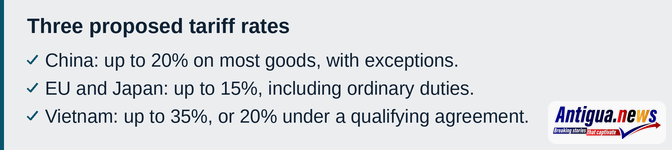
The percentages mean different things at the border. For most Chinese goods, the proposed rate of up to 20 percent would take account of duties already charged under a separate forced-labor trade action. One list of products would face up to 10 percent. Another, including the fishhooks, would be exempt. The administration also raised the possibility of a levy of up to 40 percent on all Chinese goods if it judged talks with Beijing inadequate.

For merchandise from the EU and Japan, the proposed 15 percent figure includes ordinary customs duties and takes account of existing Section 301 tariffs. A European product already carrying a 5 percent ordinary duty would, on the simplest calculation, face another 10 percentage points to reach 15. That example assumes the product is covered and no other relevant duty applies.
There is a price attached to negotiating, too. Vietnam could face up to 35 percent, or 20 percent if it reaches a qualifying agreement. Singapore’s proposed rate could fall from 20 percent to 10 percent. Mexico and Norway were investigated alongside the other economies. Washington has yet to issue findings on either.
China, Japan and Europe push back
At a briefing in Beijing, China’s commerce ministry accused Washington of treating ordinary competition as a threat. Japan lodged a protest. The European Commission rejected the claim that Europe was a source of structural overcapacity. All three have reason to contest an American finding that could shape how their exports are treated for years.
In Singapore, Deputy Prime Minister Gan Kim Yong offered a small trading nation’s answer. Its manufacturers sell abroad because the home market is small, he told reporters. And the United States itself sells more to Singapore than it buys from it, a detail he stressed in the government’s transcript.

How a U.S. tariff can reach Antigua
Antigua and Barbuda is outside the group of 14. Its businesses can still encounter an American tariff on a supplier’s invoice. As Antigua.news reported in August 2025, local firms buy car parts and machinery components through U.S. distributors. If a distributor paid a duty when a Chinese-made part entered its American inventory, it could pass some of that cost on to a garage in Antigua.
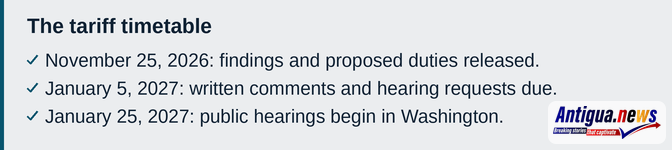
The route matters. A part shipped straight to Antigua incurs no U.S. import duty. Even a shipment passing through an American port can travel under customs bond for export. For a garage comparing quotations, the useful question is whether the U.S. wholesaler has already paid duty on the part sitting on its shelf. Washington has given importers until January 5 to comment on its plans. Public hearings start January 25. The final price of that part remains an open question.
This story was first published by Antigua News on : antigua.news/2026/11/26/trump-tariff-plan-14-trading-partners-china-eu-japan. © 2026 Antigua News. Republication without permission is not allowed.

About the author
Dr. Dario Item is the Head of Mission of the Embassy of Antigua and Barbuda in Madrid. He is an experienced financial crimes lawyer with nearly 30 years of practice. He holds degrees in law and political science, a Ph.D. in criminal law and an LL.M. in transnational financial crime. He is involved in the Credit Suisse AT1 case and represents investors affected by the write-down of the bonds.
Read our editorial standards and corrections policy. Spotted an error? Contact the newsroom.
More from Business and Finance
View section
The $70,000 problem with Nvidia’s $312 million options rumour
Trading records contradict the claim that one trader turned $3.4 million into $312 million on Jensen Huang’s return as CEO. A separate set of bets drew scrutiny at Polymarket.
By Dario Item

Novo Banco’s €2bn bond dispute exposes Portugal’s trust problem
Fresh rulings defend a decision that pushed selected creditors back into a failed bank. Foreign investors have good reason to question the reliability of Portugal’s legal protections.
By Dario Item

Nasdaq plunges 5.3% as AI fears deepen stock market sell-off
Doubts over artificial intelligence spending and the prospect of higher interest rates send technology shares tumbling, extending a bruising decline.
By Dario Item

Monaco exits FATF grey list in boost to €190bn wealth hub
The decision ends 28 months of FATF monitoring, but Monaco remains on the EU’s separate list of high-risk third countries.
By Dario Item
Comments
Be the first to comment.