
No Confidence in Any Candidate | Editorial

By Kieron Murdoch | Opinion Contributor
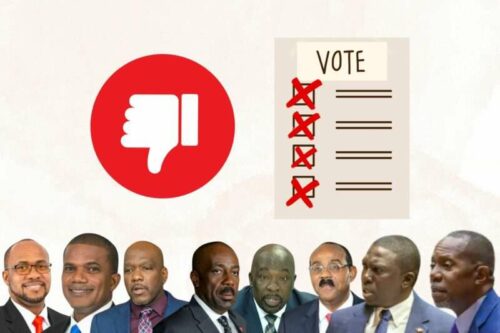
On all ballot papers for by-elections and general elections, a box corresponding to a vote of no confidence in any candidates contesting a given seat should be made available to voters.
Choosing this option should be counted as a formal indication that a voter, though eager to exercise their right, was dissatisfied with the choices available to them.
The reason we think that adding such an option would be beneficial is that it could dissuade people from abstaining from voting altogether when they are seeking a form of protest.
For many, disillusionment with politics and the political choices available to them in their constituency or nationally drive them to stay away from the polls.
As a democratic society, we ought to encourage all who are eligible to exercise their right to vote.
If that means providing an option on the ballot suitable to those who have no faith in any of the choices to at least formally indicate that, then why ever not? It would certainly be better than constantly telling people that they should merely choose the lesser of various options they do not support.
Additionally, adding such an option to the ballot may do little actual harm if it remains solely a formal indication of a lack of confidence while not interfering with the actual election itself.
By that, we mean that if no matter how many people vote no confidence, the candidate on the ballot with the most votes out of all candidates still wins, then a no-confidence option is not upsetting the ability of the election to return a candidate.
Such an option would merely have the effect of giving those who genuinely have no faith in the options available the ability to participate in the voting process nonetheless and let their vote be counted at the end of the day rather than simply stay home.
Some would suggest that a no-confidence option should be made more impactful, in that if enough people choose it, let’s say more than 50% of voters, then it should force a re-run of that election in which the nominations are reopened.
While we see the democratic value in something like this, we are also wary of the fact that a failure to elect a candidate in an election and any prolonged failure to do so can lead to political instability.
In many respects, elections are as much about the people having the chance to elect their leaders as they are about making sure that someone gets elected via a transparent and fair system as opposed to having power vacuums or political outcomes fraught with instability. It is why there is a deadline on when petitions to an election can be made after a result.
It is why we use a first-past-the-post system even though it naturally does not reflect proportionality and can deliver seat results that are not in line with proportional voter support.
The system needs to be capable of actually ensuring that someone is elected, and that the winner is seen as legitimate and is then allowed to serve their term.
Having too many opportunities for the election to be delayed, or challenged after the fact, or for there not to be a clear winner in the result, or for do-overs to be forced, creates conflict and instability, neither of which ultimately bode well for a nation.

As such, we have chosen to err on the side of caution in supporting the idea of a no-confidence option without giving it the ability to derail the actual vote.
Were such an option to be implemented in the way we envisage, it would mean, for example, that in an election in St. George with three candidates, even if 70% of voters voted no confidence in any candidate, it would not stop the candidate with, let’s say 20% of the vote, compared to their rival’s 6% and 4%, from winning the election and becoming the MP.
You might be inclined to say that is ludicrous. But our logic is that even if you allow a high proportion of no-confidence votes to quash the election and force a redo, it does not guarantee that in the next election in that constituency, you will actually get more favorable options to consider.
Political parties may put up candidates of similar ilk to the ones who were contesting when a majority voted no-confidence.
Additionally, one must be wary of how long a seat would go vacant and the implications for the nation.
If a redo was allowed to be triggered by a high no-confidence threshold, then to be fair, sufficient time would need to be allotted for the electoral authorities to prepare for another election, and for old or new candidates to campaign and make their case to the people. How long will that take?
What if a majority of voters choose no-confidence in the do-over election? That would mean another delay, and more time passing with an empty seat.
Imagine a situation where this happened in more than one constituency or where parties have a close number of seats, and a winner of the election is unclear.
Hopefully, you can understand why while we support having a no-confidence option, we do not think it should be allowed to prevent the actual election of a candidate.
Nevertheless, we think that if a significant number of voters in any individual constituency election chose no confidence or even if a majority of them did, it would send a strong signal to the nation.
Parties would have to grapple with the fact that so many voters took the time to come out and demonstrate their dissatisfaction with any option.
And those who hesitate to offer themselves for public office, questioning whether there is any room for change or space for new political movement would be emboldened to see their fellow citizens formally declare this dissatisfaction with the prevailing choices.
Ultimately, it comes back to the issue of representation and the importance of broad participation.
If a voter genuinely does not feel represented by the philosophy, values, or programme of the candidates or parties on the ballot, what are they to choose? Do they simply spoil their ballot in protest? Do they stay home altogether? What harm would it do – except to the egos of political parties – to have a no confidence option on the ballot?
About the writer:
Kieron Murdoch is an opinion contributor at antigua.news. He worked as a journalist and later as a radio presenter in Antigua and Barbuda for eight years, covering politics and governance especially. If you have an opinion on the issues raised in this editorial and you would like to submit a response by email to be considered for publication, please email [email protected].
This story was first published by Antigua News on : antigua.news/2025/01/13/no-confidence-in-any-candidate-editorial. © 2025 Antigua News. Republication without permission is not allowed.

About the author
The Editorial Staff refers to all reporters employed by Antigua.news. When an article is not an original creation of Antigua.news—such as when it is based on a press release, other media articles, letters to the editor, or court decisions—one of our staff members is responsible for overseeing its publication.
Read our editorial standards and corrections policy. Spotted an error? Contact the newsroom.
More from Editorial
View section
Before You Shoot, Think: An Open Letter to the Young People of Antigua and Barbuda
By Dario Item

From Captive Child to Russian General: Hannibal, the Unconquered Mind and the Unfinished Work of Emancipation
By Editorial Staff

LETTER: Our Children Need Extra Protection
By Editorial Staff

Water, Flour, And Smoke: Assertion Is Not Fact—And Propaganda Is Not Proof | EDITORIAL
By Editorial Staff
Comments (5)
Listening Post January 13, 2025, 7:36 PM
Ping January 14, 2025, 12:34 AM
Faithful National #1 January 14, 2025, 7:39 AM
However. much more Voter Education needs to be introduced and the electorate must be willing to shake off their slave-like mentality and break the cycle of expecting a gift 🎁 in exchange for a vote.
Unfaithful non-national January 14, 2025, 7:24 PM
Faithful National #1 January 23, 2025, 10:19 AM