
Paralysed man walks again thanks to electronic brain implants

By Mick the Ram
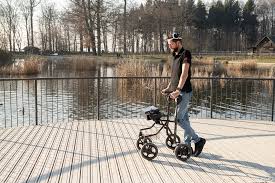
A team of Swiss neuroscientists have given a paralysed man the ability to walk again thanks to electronic brain implants, that use wireless signals to reconnect the brain with the spinal chord, through restored communication.
Gert-Jan Oskam was told he would never walk again after breaking his neck in a traffic accident in China 12 years ago, but since receiving the delicate “digital bridge” surgery in July 2021 he has been able to climb stairs and walk smoothly for more than 100 metres, albeit at a very gentle pace, simply by using his own thought processes.
The scientists have a long-standing programme to develop brain-machine interfaces which they envisage will eventually be able to assist people in overcoming paralysis, but they stress that the system is still at a basic research stage and therefore is many years away from being available to all paralysed patients.
Signalling a change for the better
The implants send signals to the muscles that are needed to flex the hip, knee, and ankle joints and have allowed Mr Oskam, a 40 year-old Dutchman, to have movement that he believed had left him for ever. “I can stand up and have a beer with my friend which is a pleasure that many people do not appreciate. Now I can just do what I want, when I decide to make a step the stimulation will kick in as soon as I think about it,” he said enthusiastically.
Delicate operation
Professor Jocelyne Bloch, a neurosurgeon at Lausanne University, who undertook the intricate procedure, explained how she cut two circular holes on each side of Mr Oskam’s skull which were approximately 5cm in diameter, immediately above the parts of the brain that control movement. This was followed by the insertion of two disc-shaped implants which wirelessly transmitted brain signals to two sensors attached to a helmet on his head.
An algorithm was then developed by the team which translated those signals into instructions to leg and foot movement, via a second implant inserted around his spinal cord, which Professor Bloch had expertly attached to the nerve endings, that are related to the ability to walk.
Finally, electrodes were installed onto Mr Oskam’s brain which detect neural activity whenever he tries to move his legs. The readings it produces are turned into pulses, which are sent to further electrodes in his spine to activate nerves and in turn, switch on muscles to produce the intended movement.

Hope for spinal injury patients
Recognising the value of their work, Professor Bloch said: “The important thing for us is not just to have a scientific trial, but eventually to give more access to more people with spinal cord injuries who are used to hearing from doctors that they have to get used to the fact that they will never move again.” It brings hope where previously there was none.
Greater control
These brain implants crucially build on the earlier work of Professor Grégoire Courtine of the École Polytechnique Fédérale in Lausanne (EPFL), which used a spinal implant to restore movement. Mr Oskam had the spinal implant before he had the brain implants and made the observation: “I felt before that the system was controlling me, but now I am controlling it”
Huge potential
Professor Courtine was keen to look to the future with enormous optimism. “Gert-Jan received the implant 10 years after his accident; but imagine when we apply our brain-spine interface a few weeks after an injury, the potential for recovery is tremendous.”
About the author
Mick Burrows is an independent freelance author based in the UK, boasting over 20 years of experience in the online writing landscape. His extensive background has enabled him to develop a diverse range of material, marked by a unique and distinct style. Recognized as a platinum-level expert author by leading e-zine publications, Mick excels in optimizing content for Search Engine Optimization (SEO) through effective keyword density and distribution. He has served as the lead reviewer for a travel enterprise and the senior previewer at a sports prediction company, melding his passions for sport—particularly football and cricket—with his love for travel, having explored more than 50 countries worldwide.
Read our editorial standards and corrections policy. Spotted an error? Contact the newsroom.
More from Culture, Science and Tech
View section
VIDEO: As School Reopens, Simon Bolivar Pre-School’s Garden serves as a Model for teaching Agriculture in Early Childhood
By Editorial Staff

CUB Hells Gate Crowned 2026 Panorama Champions After Electrifying Carnival Showdown
By Cory Wayland

From Potters to Dallas: Antiguan and Barbudan Ryancia Henry Rises to Top Luxury Hotel Management Role
By Shermain Bique-Charles

Five Female Chefs Wow Diners With Multi-Course Dinner at Hodges Bay Resort
By Shermain Bique-Charles
Comments
Be the first to comment.
Comments are temporarily unavailable.