












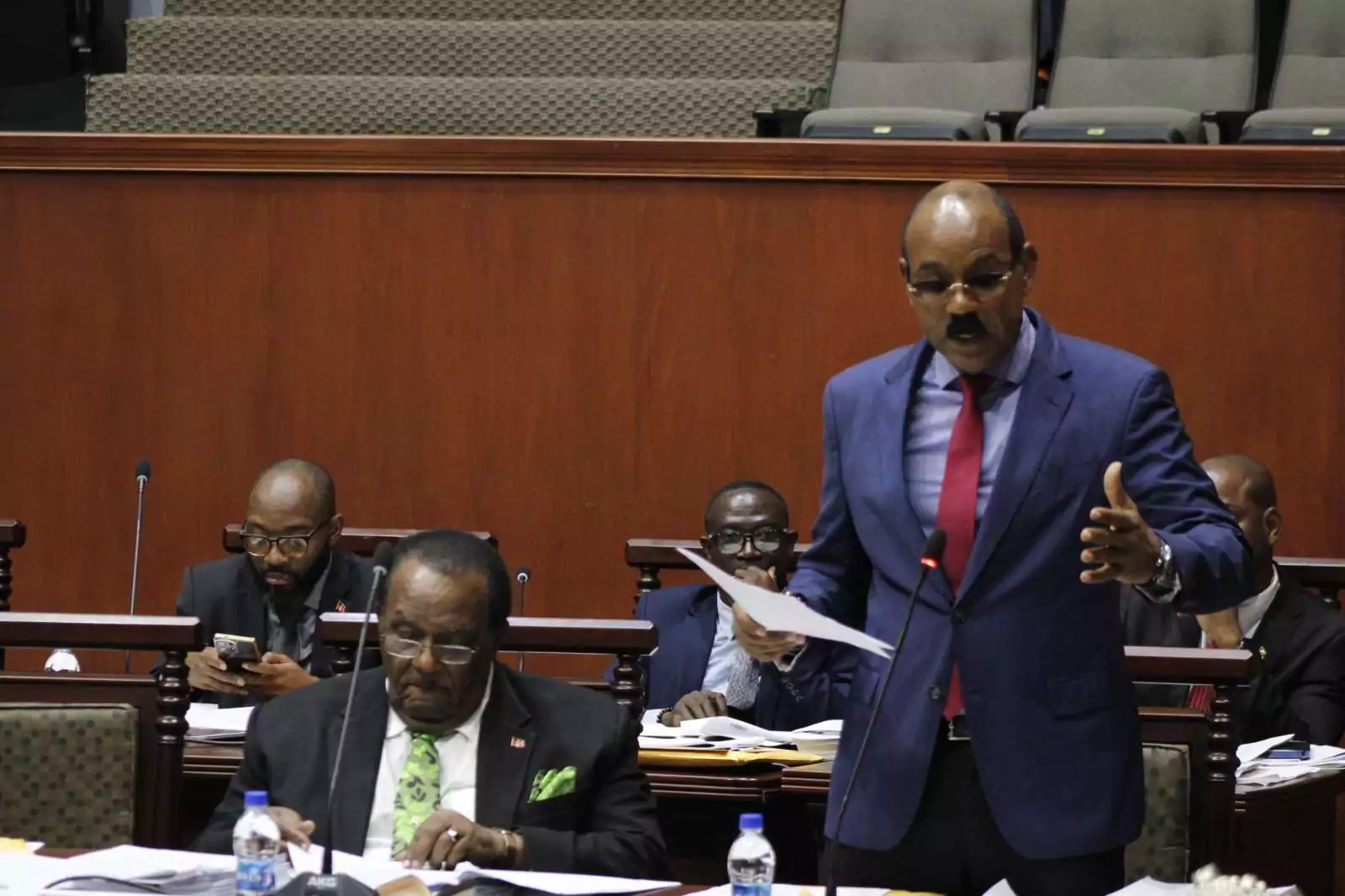
Prime Minister Gaston Browne Speaking at Parliament (photo by Robert Emanuel)
Parliament on Tuesday approved a White Paper establishing the framework that will govern Antigua and Barbuda’s ongoing negotiations with the United States over the possible transfer of third-country nationals removed from the U.S., with Prime Minister Gaston Browne insisting that the country will never compromise its sovereignty or national security.
The White Paper, which was passed following debate in the House of Representatives, sets out the safeguards and conditions that will guide any future arrangement with Washington. It also places the government’s negotiating position on the official parliamentary record.
Presenting the measure, Prime Minister Browne said the government remains prepared to face U.S. visa restrictions rather than agree to accept individuals who pose a threat to Antigua and Barbuda.
“We know that the United States could take punitive action, and already there are visa restrictions against Antigua and Barbuda,” Browne told Parliament. “But if we were faced with an option of not taking criminals and to have visa restrictions, we will go for the visa restrictions because accepting criminals will destroy our country.”
The Prime Minister sought to reassure the public that no final agreement has been signed and that discussions with the United States have been ongoing since August last year. He stressed that the government’s approach has been measured, deliberate and guided solely by the national interest.
“Our government approach on this issue is neither with hostility nor with haste,” Browne said. “We have carefully examined every proposal to ensure it does not undermine the country’s security or quality of life.”
While reaffirming Antigua and Barbuda’s longstanding friendship with the United States, Browne said cooperation would never come at the expense of the nation’s development or security.
“It is not in our interest to have any acrimonious relationship with the United States,” he said. “We have to continue to be a very friendly and cooperative nation, but not to the extent where it undermines our own development.”

Addressing concerns about the types of individuals who could potentially be transferred, the Prime Minister said the government has made it clear that it will not accept violent offenders or hardened criminals.
According to Browne, the principal point of disagreement during negotiations has been the wording of the proposed agreement. Antigua and Barbuda requested language explicitly excluding criminal offenders, but U.S. officials reportedly indicated that such wording could create legal complications because immigration and visa violations are technically classified as criminal offences under American law.
The government has since proposed revised language that would permit consideration only of individuals whose offences relate solely to immigration or visa violations while excluding persons convicted of serious crimes.
“We don’t want criminal elements,” Browne declared.
The White Paper reflects that position by preserving Antigua and Barbuda’s authority to evaluate every proposed transfer individually. It allows the government to approve or reject each case and gives the country the right to terminate any arrangement if it is deemed contrary to the national interest.
Browne also rejected opposition claims that the government has already entered into a binding agreement with the United States. He explained that the only document executed to date is a Memorandum of Understanding (MOU), which he said creates no legal obligation for Antigua and Barbuda to receive any individual.
He maintained that the MOU does not grant anyone an automatic right of entry and does not diminish the government’s sovereign authority to determine who may enter, remain in or be removed from the country.
In an effort to promote transparency, the Prime Minister announced that all documents related to the negotiations would be tabled in Parliament and deposited in the National Archives so the public can review them.
He said the move was intended to counter misinformation surrounding the negotiations and ensure there is a permanent public record of the government’s position.
Despite acknowledging the diplomatic imbalance between Antigua and Barbuda and the United States, Browne said his administration will continue negotiating respectfully but firmly while placing the safety and sovereignty of the nation above all else.
“The national security of Antigua and Barbuda is not negotiable,” Browne told lawmakers, reiterating that the government will not accept any arrangement that could endanger the country’s people or compromise its sovereign right to determine who enters its


Congratulations ..as we should
I appreciate the transparency